
Dior Cannage & Charms Explained
By The Old Fashioned Club team
The Cannage motif, the D.I.O.R. charms and Dior charms: origin, meaning and variations. The plain-spoken guide to the house's codes by Old Fashioned Club.
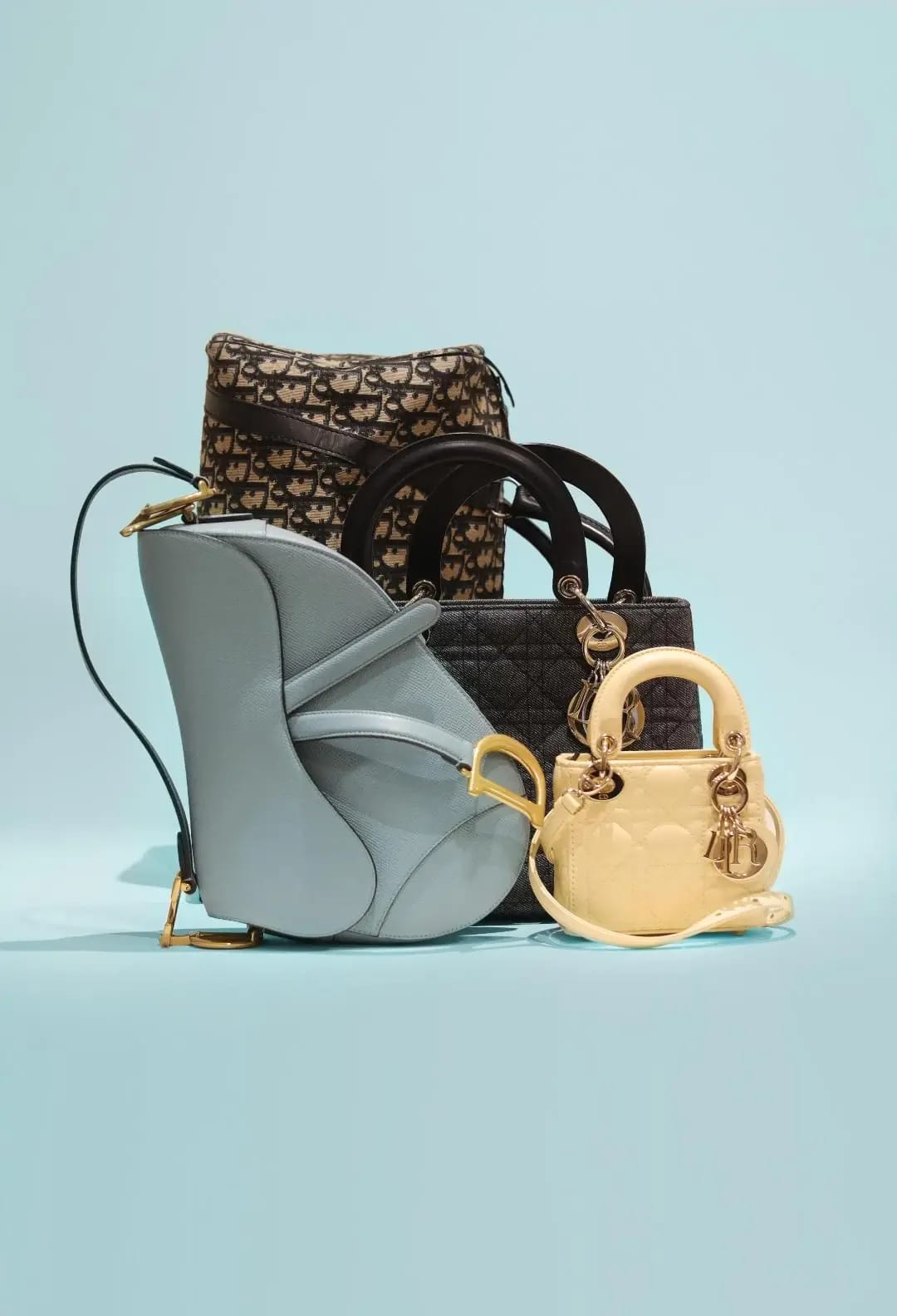
Cannage and charms are Dior's two visual signatures. Cannage — that motif of interlaced diamonds — comes from the Napoleon III chairs on which Christian Dior seated his guests at his first shows. The charms, for their part, spell out the house's name or evoke its codes. Together, they turn a bag into an instantly recognisable object.
At Old Fashioned Club, a Parisian luxury pre-owned boutique, understanding these codes is essential: they tell the story of the house and serve as markers of authenticity. Here is everything you need to know.
The origin of Cannage: Monsieur Dior's chairs
On 12 February 1947, Christian Dior presented his first collection on Avenue Montaigne. To seat the press and clients, he chose Napoleon III-style medallion chairs, with backs woven in cane. These chairs, elegant and timeless, became a symbol of the house's world.
The Cannage motif — those regular diamonds evoking woven wicker or rattan — was then adopted as Dior's graphic signature. It first appeared as a subtle nod, then, from 1995 with the Lady Dior, as the emblematic quilting of the house's leather goods.
Quilted Cannage is more than mere ornament: it is demanding atelier work. Each diamond is stitched with millimetric precision, the padding creates the relief, and the perfect regularity of the motif is one of the signatures of Dior craftsmanship — and one of the first clues to authenticity.
The variations of Cannage
Cannage is not limited to the raised quilting of the Lady Dior. The house has reinterpreted it in many ways:
- Quilted Cannage (stitched relief): the best-known version, on the Lady Dior and small leather goods.
- Tone-on-tone Cannage: discreet diamonds in the same colour as the leather, for an understated effect.
- Perforated or openwork Cannage: on certain pieces and shoes.
- Embroidered or embellished Cannage: runway versions enriched with pearls, crystals or embroidery.
- Micro-Cannage and macro-Cannage: variations in the scale of the diamonds depending on the models and seasons.
Each variation keeps the same geometric grammar, ensuring the house's visual coherence over time.
The D.I.O.R. charms: meaning and symbolism
The most famous charms are the four metal charms spelling out "D.I.O.R." hanging from the handle of the Lady Dior. Beyond the obvious — they form the house's name — a poetic interpretation has circulated for years, often attributed to the house itself: "D for Dieu (God), I for the Eye (or Idol), O for Or (Gold), R for Rêve (Dream)".
Whether official or apocryphal, this formula captures something true about the Dior spirit: a luxury that aspires to elevation, to pure beauty, to an imaginative world that goes beyond the object. The charms chime with every step — a sonic detail that became a signature.
From a practical point of view, these charms are also a major marker of authenticity: their weight, their engraving and their finish are difficult to reproduce correctly.
The other charms and symbols of the Dior world
Dior multiplies the charms and symbols that punctuate its collections:
- The stirrup / saddle charm of the Saddle, a tribute to John Galliano's equestrian inspiration.
- The interlocking "CD" letters, the house's historic monogram.
- The bee, an imperial emblem dear to the house, embroidered or appliquéd.
- The star, Christian Dior's personal good-luck charm, as he set great store by signs and superstitions.
- The lily of the valley, the couturier's signature flower, which he slipped into his hems for luck.
- The customisable charms (letters, motifs) of recent straps, notably on the reissued Saddle and Book Tote.
These symbols are not decorative at random: they draw on the biography of Christian Dior, a superstitious and sentimental man, which gives the house's world a rare narrative depth.
Cannage and charms as markers of authenticity
Because they are Dior's most visible signatures, Cannage and the charms are also the most counterfeited — and therefore the most revealing. When you examine a pre-owned Dior:
- Authentic Cannage is perfectly regular, its stitching clean and continuous, its relief even. An irregularity in size or a misalignment at the corners is suspect.
- Authentic charms are dense, deeply engraved, with a uniform gilding. Lightness or blurry engraving betrays a copy.
These two elements are at the heart of our authentication protocol. For the full method, see our tutorial on how to authenticate a Dior bag. At Old Fashioned Club, every Dior piece is expertised — notably via Entrupy — and accompanied by a certificate of authenticity.
Discover our pre-owned Dior bags, our pre-owned Lady Dior and the Christian Dior world.
Frequently asked questions
- Where does Dior's Cannage motif come from?
- Cannage is inspired by the Napoleon III-style medallion chairs, with cane-woven backs, that Christian Dior used to seat his guests at his first show in 1947 on Avenue Montaigne. This diamond motif became the house's graphic signature, taken up as emblematic quilting on the Lady Dior from 1995.
- What do the letters D.I.O.R. on the Lady Dior charms mean?
- They simply spell out the house's name. A frequently cited poetic interpretation suggests "D for God, I for the Eye, O for Gold, R for Dream". Official or not, this formula conveys the Dior spirit: a luxury that aspires to elevation and pure beauty. The charms chime with every step, a detail that became a signature.
- What are the other emblematic symbols of Dior?
- Beyond Cannage and the D.I.O.R. charms, the house uses the bee (an imperial emblem), the star and the lily of the valley (Christian Dior's good-luck charms, as he was superstitious), the interlocking CD monogram, and the stirrup charm of the Saddle. These symbols draw on the couturier's sentimental biography.
- Does Cannage come in several versions?
- Yes. There is raised quilted Cannage (the best known, on the Lady Dior), tone-on-tone Cannage, perforated or openwork Cannage, embroidered or embellished runway Cannage, as well as variations in scale (micro and macro-Cannage). All keep the same geometric diamond grammar.
- Is Cannage a good marker for authenticating a Dior?
- Yes, it is one of the first. Authentic Cannage is perfectly regular, with identical diamonds, clean continuous stitching and even relief, even at the corners. An irregularity in size or a misalignment is suspect. Combined with checking the charms, it is a major clue. *Old Fashioned Club — 4 rue des Saussaies, 75008 Paris. Mon-Fri 10am-7pm | Sat 11am-7pm.*
Related articles

Pre-Owned Loro Piana: The Quiet Luxury Buyer's Guide
Cashmere, vicuña, Summer Walk loafers: icons, materials, authentication and resale value of pre-owned Loro Piana. The OFC guide to buying quiet luxury at a fair price.

Pre-Owned Givenchy: A Guide to the Antigona, Pandora & Parisian Chic
Antigona, Pandora, the legacy of Hubert de Givenchy: icons, leathers, authentication and resale value of pre-owned Givenchy. The OFC guide to buying at a fair price.
How to Estimate the Value of Your Pre-Owned Luxury Bag
How to estimate the value of your pre-owned luxury bag: house, model, condition, rarity, colour, accessories. The factors that set the price, explained by Old Fashioned Club.