
How to Authenticate a Chanel Bag: The Complete 2026 Guide
By Camille Laurent, Authentication Expert — Old Fashioned Club
Learn to authenticate a pre-owned Chanel bag in 2026: stitching, serial number, lining, hardware. Expert guide from Old Fashioned Club Paris.

Buying a pre-owned Chanel bag is one of the most exciting — and sometimes most nerve-wracking — decisions you can make in the world of luxury. The second-hand market is exploding: in 2025, the pre-owned luxury-bag segment surpassed €35 billion worldwide. With that growth comes, inevitably, a proliferation of ever more sophisticated counterfeits.
At Old Fashioned Club, a Parisian boutique specialising in pre-owned luxury since 2017, we have authenticated thousands of Chanel pieces — from iconic Classic Flaps to contemporary Boy Bags, by way of vintage rarities from the 1980s. Our process combines the eye of our experts with Entrupy technology (AI and microscopy authentication, with certificate), also available on request. This guide distils our field expertise into a rigorous verification protocol that any serious buyer can apply.
Why authenticity is crucial in the pre-owned luxury market
The world of pre-owned luxury is not homogeneous. There are serious, certified resellers who apply strict authentication protocols — and less scrupulous platforms where anyone can list a bag for sale. The difference can cost you between €3,000 and €15,000.
Chanel is the most counterfeited brand in the world in the ultra-luxury segment. An authentic 2.55 Classic Flap in quilted lambskin now trades between €8,000 and €15,000 on the pre-owned market, depending on the size, the colour and the condition. A medium-to-large Boy Bag sits between €4,500 and €8,000. At these price levels, vigilance is not an option: it is an absolute necessity.
Counterfeiters now invest considerable sums to improve their output. "Super fakes" — the term for high-end counterfeits — can fool an untrained eye and even, at times, experienced buyers who do not know exactly what to look for. Our guide gives you the keys to never being caught out.
There is also the matter of value to understand. An authentic Chanel bag is an asset that, well kept, maintains or increases its value. A counterfeit, on the other hand, is worth nothing — and reselling it later is a criminal offence.
The 8 essential checkpoints
2.1 The stitching: the signature of Chanel excellence
Chanel's artisans produce between 8 and 12 stitches per centimetre depending on the model and the stitching area. On a Classic Flap, count roughly 10 stitches per centimetre on the exterior seams of the quilting. The regularity is absolute: not one stitch larger, not one smaller, no deviation in alignment.
Turn the bag inside out. The interior stitching must be as perfect as the exterior — Chanel makes no invisible compromise. The thread is always matched to the leather; on a black bag, the thread is black. On a beige one, the thread is beige. Any discrepancy is an immediate alarm signal.
On quilted models, check that the diamonds align perfectly at the side seams and at the closure. This is one of the most complex technical challenges of the craft — and one of the first things counterfeiters get wrong.
2.2 The serial number and the hologram
Since 1984, Chanel has affixed a holographic sticker inside every bag, accompanied by an authenticity card bearing the same number. This number is your first line of defence — and its history is fascinating (see section 4).
The hologram must be firmly stuck inside the bag, usually in a pocket or sewn into the lining. It should not peel off, ripple, or show air bubbles. The texture is slightly grainy to the touch. Under direct light, it displays well-defined rainbow reflections.
2.3 The double C: precision geometry
The Chanel logo — two interlocking Cs — follows a perfectly defined geometry. The left C passes in front at the top and behind at the bottom. The right C passes behind at the top and in front at the bottom. This rule is absolutely constant on all authentic Chanels.
On a CC clasp, check the symmetry and the thickness of the letters. Counterfeits often show Cs that are too thick, too thin, asymmetrical, or with the interlacing reversed. This detail seems simple — yet counterfeiters get it wrong with disconcerting regularity.
2.4 The lining: uncompromising interior quality
Chanel mainly uses three types of lining depending on the collection and the era: burgundy, ecru beige and black. For contemporary bags, the fabric lining is thin but of remarkable density, with no loose threads or puckering.
The interior stitching is clean and finished. The interior pockets are evenly proportioned. The "CHANEL" inscription is stamped on the leather of the interior tab with perfect typographic precision: upright font, even spacing, uniform impression depth. Beware of an inscription that is blurry, poorly aligned, or of irregular depth.
2.5 The hardware: weight, finish and engraving
Chanel hardware — chains, clasps, rings — is always heavy. Take the bag in hand: there must be a palpable resistance linked to the weight of the metal elements. A bag that feels "light" for its size is often suspect.
The engravings on the hardware must be sharp, deep and uniform. On the turn-lock clasps of the Classic Flap, the "CHANEL" engraving is fine but perfectly legible. The leather-laced chains — the signature of the Classic Flap since the 1950s — must show a perfectly regular alternation, with no leather segment too short or too long.
2.6 The closures: function and alignment
The zip of an authentic Chanel — when the model has one — is signed YKK or Lampo, two high-end zip manufacturers. It slides with absolute fluidity, without catching or resistance. The pull tab often bears the CC logo.
On the Classic Flap, the turn-lock clasp turns with a light, even resistance. It does not "snap", does not force, does not wobble. The alignment between the clasp and its counterpart is to the millimetre.
2.7 The dustbag and the authenticity card
Every Chanel bag sold new comes with a white or cream fabric dustbag with the embroidered CC logo. On the pre-owned market, not all accessories are necessarily present — but their presence is a plus and their authenticity must be verified.
The authenticity card is a rectangle of rigid cardboard, with the serial number printed (not hand-stamped). The font is consistent and the printing is sharp. The paper is high quality. Beware of cards that appear to be printed on ordinary paper or whose digits are slightly pixelated.
2.8 The "smell test": the nose as an authentication tool
This point is less well known but remarkably effective. Chanel leather — lambskin, caviar, or other — gives off a characteristic scent: a noble, slightly tanned, subtle leather smell. Fake bags, especially those mass-produced with poor-quality leathers, often give off a chemical, acrid or synthetic odour.
Open the bag and smell the interior. The lining should smell good. A bag that smells of plastic, glue, or that gives off a strong chemical odour deserves heightened attention.
The most common fakes: what to look for
The "mirror" and "AAA"
The counterfeit market is structured into quality tiers. At the bottom, "AAA" or "first copy" replicas are crude: rough stitching, misaligned logo, light and dull hardware. They rarely fool an attentive buyer.
In the middle, "mirror" replicas (also called "1:1") are produced from in-depth analyses of the originals. They sometimes use real leather and heavier metal components. The hologram is imitated. The authenticity card is forged. These replicas can cost 500 to 800 euros to produce — and be resold as authentic pieces for €3,000-6,000.
"Super fakes": the serious threat
Super fakes represent the pinnacle of counterfeiting. Produced mainly in China in clandestine workshops that sometimes employ former luxury leather-goods workers, they use leathers close to the originals, heavy hardware, and precisely reproduced holograms.
To identify them, experts focus on the details that are technically difficult to reproduce identically: the precise tension of the stitching, the specific smell of Chanel leather, the exact quality of the holographic reflection, and above all the consistency of the serial number with the presumed date of manufacture.
The importance of the Chanel serial number: a history of holograms by decade
The Chanel numbering system is a powerful authentication tool — provided you know how to read it.
Before 1984: no serial number. Vintage bags predating this date do not have one, and that is normal.
1984-1986: 6-digit series beginning with 1 or 2 (e.g. 1XXXXXX or 2XXXXXX, sometimes without a hologram on the very first series).
1987-1990: introduction of the silver hologram. 7-digit series beginning with 0, 1, 2 or 3.
1991-1999: hologram with a black background. 7-digit numbers, series 4 to 10.
2000-2005: red hologram. Series roughly 8 to 13 million.
2005-2012: gold hologram. Series roughly 14 to 18 million.
Since 2021: Chanel has replaced the hologram system with NFC authenticity cards bearing a QR code, on new production. This change is crucial: a bag presented as "recent" with an old hologram deserves verification.
The consistency between the serial number and the bag's general condition, design and hardware is essential. A Classic Flap presented as dating from 2010 with a serial number corresponding to the 1990s should immediately arouse suspicion.
Having a bag authenticated by an expert: when and how
Even with this guide in hand, certain situations warrant turning to a professional expert.
Call on an expert if:
- The seller cannot provide a clear provenance
- The price seems too low relative to the market (a Classic Flap at €3,000 is impossible on the legitimate market)
- The serial number or the hologram seems suspect to you
- It is a rare or vintage model (pre-1990) for which references are less accessible
- The purchase is being made remotely, with no possible physical inspection
Independent authentication services exist: Entrupy (AI technology), Real Authentication, or the in-house experts of the major certified pre-owned boutiques. Costs range from €20 to €150 depending on the service and the model — trifling next to the value of an authentic bag.
Buying a pre-owned Chanel bag with confidence at Old Fashioned Club
At Old Fashioned Club, every piece we sell goes through a 15-point authentication protocol before joining our selection. We take no risks — neither for ourselves nor for our clients.
Our showroom at 4 rue des Saussaies, Paris 75008 (Mon-Fri 10am-7pm, Sat 11am-7pm) lets you examine each bag in person, under natural and artificial light, with the support of our team of experts. No retouched photos, no distance: you see exactly what you are buying.
Every piece comes with an Old Fashioned Club certificate of authenticity, and we offer international shipping throughout France. Our selection of pre-owned Chanel bags is renewed regularly with carefully chosen pieces: Classic Flaps in every size, Boy Bag, Timeless Clutch, and vintage rarities.
If you already own a Chanel and wish to sell it, our selling service offers transparent terms and a free estimate. We also buy pieces from other great houses — see our selection of all our pre-owned luxury bags.
Frequently asked questions
- Can a Chanel bag be authenticated by the serial number alone?
- No. The serial number is an important clue, but it can be reproduced on a counterfeit. Authentication must always be multi-criteria: number + hologram + stitching + hardware + lining + overall consistency. No single element is enough.
- My vintage Chanel bag has no serial number. Is that normal?
- Yes, if the bag was made before 1984. The numbering system was only introduced in 1984. An authentic vintage bag from the 1970s or early 1980s will not have one. Dating and authenticating these pieces then relies on other criteria: hardware, leather type, the shape of the Cs, and so on.
- Are super fakes really undetectable?
- No, never completely. Even the best counterfeits show inconsistencies detectable by an expert. The tension of the stitching, the exact quality of the holographic reflection, the smell of the leather, the precise geometry of the logo: these elements combined always reveal a piece's authenticity to an experienced eye.
- Is a pre-owned Classic Flap at €4,000 suspect?
- Most probably, yes. An authentic Classic Flap in good condition trades at a minimum of €5,000-6,000 in mini or small size, and rises to €12,000-15,000 for large formats or rare versions. An abnormally low price is the most universal alarm signal.
- How do I verify a Chanel bag bought online?
- Systematically insist on: high-resolution photos of the hologram and authenticity card, of the interior and exterior stitching, of the hardware and engravings, of the interior inscription on the tab, and of the bag's provenance. Favour sellers who offer a written authenticity guarantee and a right of return.
- Does the new NFC card replace the hologram on all Chanels?
- Only on new production since roughly 2021. Bags made before that date keep their period hologram. On the pre-owned market, you will therefore find both systems depending on the age of the piece.
- Does Old Fashioned Club offer an authenticity guarantee?
- Yes, absolutely. Every bag sold by Old Fashioned Club comes with a certificate of authenticity issued by our house. Should there be any doubt about the authenticity of a piece bought from us, we commit to a full refund. This has been the foundation of our reputation since 2017. **Ready to find your authentic Chanel?** Explore our collection of [pre-owned Chanel bags](https://oldfashionedclub.com/sacs-chanel-occasion/) or visit us at 4 rue des Saussaies, Paris 75008. Our team welcomes you Monday to Friday from 10am to 7pm, and Saturday from 11am to 7pm. Every piece tells a story — we make sure it is a true one.
Related articles
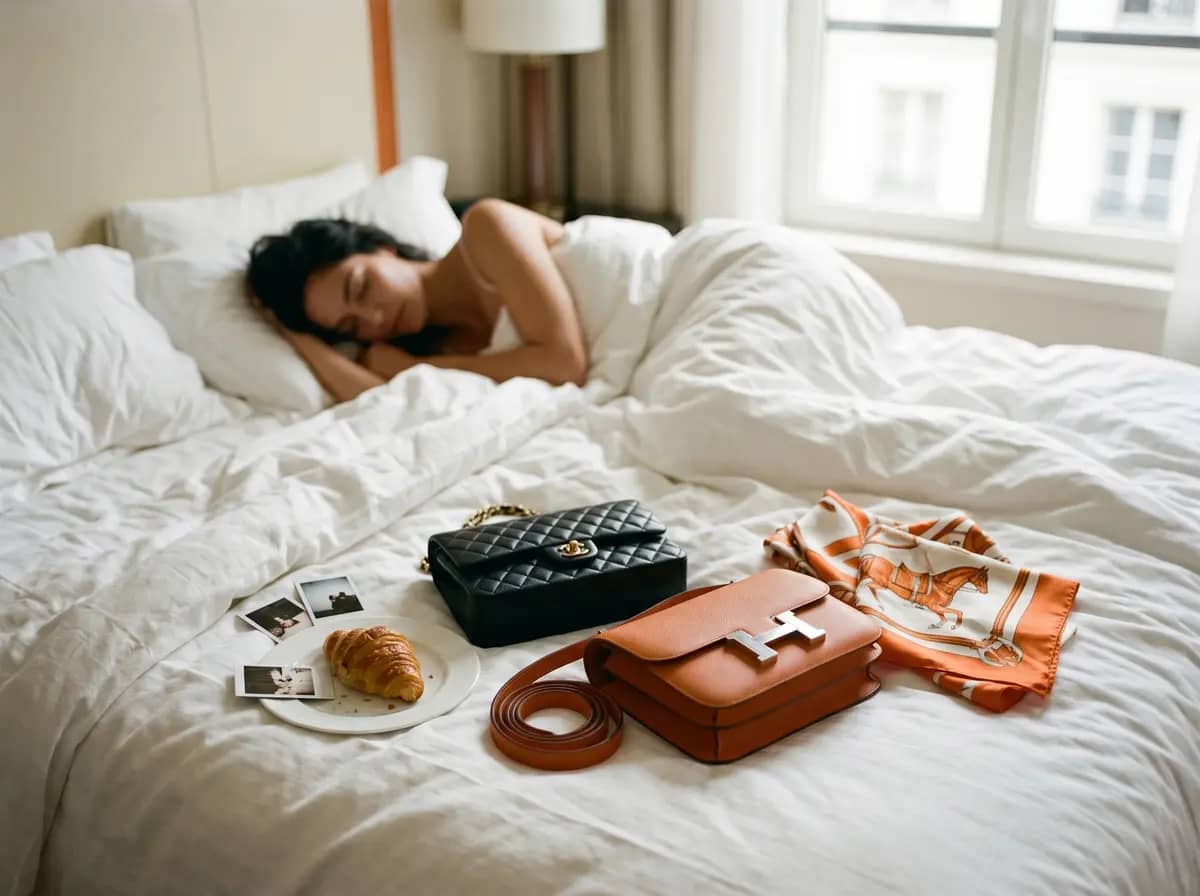
Pre-Owned Loro Piana: The Quiet Luxury Buyer's Guide
Cashmere, vicuña, Summer Walk loafers: icons, materials, authentication and resale value of pre-owned Loro Piana. The OFC guide to buying quiet luxury at a fair price.

Pre-Owned Givenchy: A Guide to the Antigona, Pandora & Parisian Chic
Antigona, Pandora, the legacy of Hubert de Givenchy: icons, leathers, authentication and resale value of pre-owned Givenchy. The OFC guide to buying at a fair price.
How to Estimate the Value of Your Pre-Owned Luxury Bag
How to estimate the value of your pre-owned luxury bag: house, model, condition, rarity, colour, accessories. The factors that set the price, explained by Old Fashioned Club.